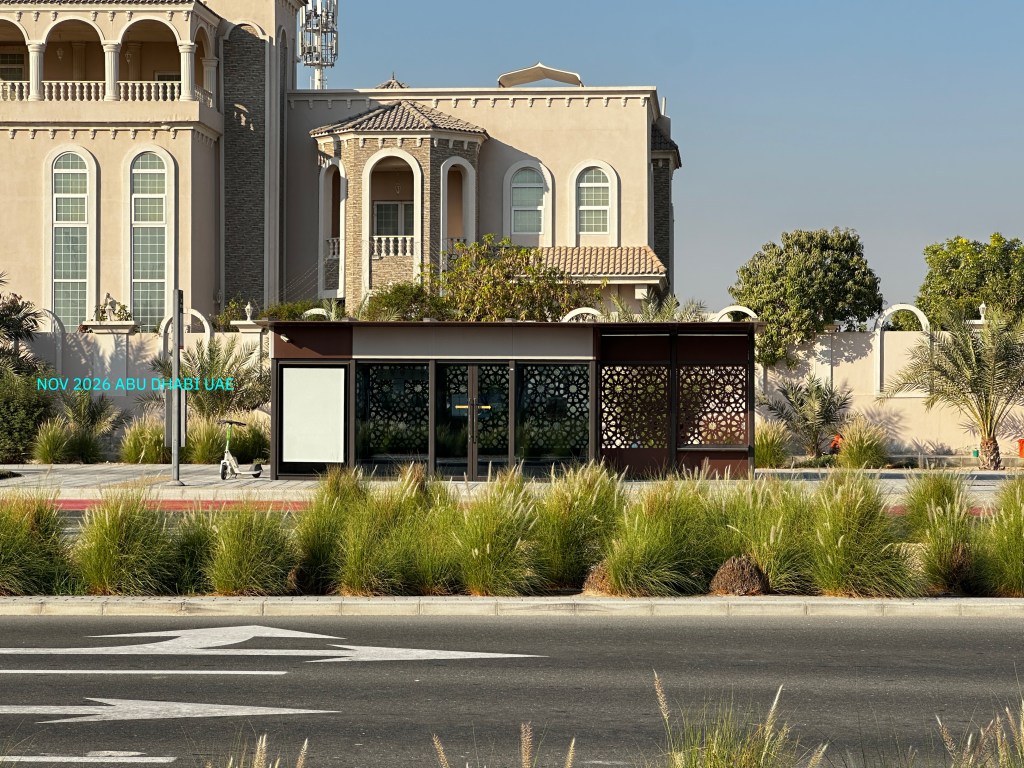
An air-conditioned bus shelter can seem like exactly what I need on a hot day in Abu Dhabi.
Yet some of the shelters I have encountered feel small enough that I hesitate to wait inside. I appreciate the relief they offer, but the enclosed space does not always feel comfortable when several people need to share it.
That small hesitation says something about how I experience public transit.
A service can be available, and I can appreciate its usefulness, while still thinking carefully about whether I want to make the journey.
The difference becomes especially important when it is a trip I need to repeat.
Living Without Needing a Car
For a long time, living in cities with useful public transportation meant that I rarely felt a strong need to drive.
Buses and trains gave me ways to reach the places around which my life was organized. Having those connections allowed me to get on with the day without making a car central to it.
Public transit has also helped me get around Abu Dhabi.
But the places I want to visit are spread across different areas, and some involve a substantial journey beyond downtown. Exploring farther out makes the convenience of a car more apparent to me, particularly in summer.
I do not see those experiences as contradictory.
I can value public transit while recognizing that it does not feel equally practical for every trip. What interests me is when it becomes a choice I can make comfortably, rather than a connection I know exists but hesitate to use.
The Time Before the Bus Arrives
Waiting is one of the parts of a journey I think about before leaving.
I want to know how long I am likely to wait and what that time will be like. A few minutes in comfortable surroundings feel different from the same minutes spent outside in summer heat.
Air-conditioned shelters address an important part of that experience. Their presence tells me that waiting has received attention.
But their capacity and arrangement matter too.
If the enclosed area feels too crowded to enter, I am left deciding between the heat outside and the close quarters within. The shelter has provided protection, but I still have to judge whether I can comfortably use it.
This makes me look at a bus stop as a small public space, not simply a marker along a route.
It needs room for people waiting, people approaching, and people moving toward the bus when it arrives. Its relationship to the sidewalk matters, as does the ability to see the approaching service without repeatedly stepping outside.
The waiting area is already part of the transit experience. I do not begin evaluating the journey only after boarding.
Sharing the Ride
Crowding is another consideration I bring to the decision.
I have experienced busy buses in several cities: people standing close together, passengers trying to make their way toward the door, and limited room as others board.
In Abu Dhabi, I have also encountered crowded buses outside the times I would normally associate with the morning or evening commute.
I cannot establish the reason from my own trips. But it reminds me not to imagine everyone’s working day as the same journey to an office in the morning and home in the evening.
People working different shifts, attending appointments, shopping, or moving between jobs may need the service at other times. The level of service throughout the day deserves attention alongside the busiest commuting periods.
Inside the buses I have used, the seating reserved for women toward the front was another arrangement I noticed. It made me aware of how the interior accommodates different passengers within one shared space.
Beyond the seating itself, I notice how easily people can board, stand, and reach the exit.
Since the pandemic, I have also become more conscious of cleanliness and close contact in crowded spaces. That has made me more hesitant about journeys where I expect to spend a long time pressed among other passengers.
I do not expect public transportation to feel like traveling alone. I do value enough room to move without every change of position becoming a negotiation.
When the Connections Feel Easier
A trip from Abu Dhabi to downtown Dubai, including Dubai Mall, offered a more encouraging experience.
Traveling by bus, rail, and Metro felt more straightforward than I had expected. I appreciated the clean, comfortable surroundings and the way the different parts of the journey connected.
What stayed with me was not only the experience aboard the train. It was being able to continue toward my destination without the trip feeling dominated by waiting outdoors.
I would still approach the journey differently in summer. Any walking or waiting between services becomes more significant when the weather makes being outside demanding.
But that trip helped clarify what makes a connection work for me.
Changing vehicles is not necessarily the most difficult part. The experience depends on how far I need to move between them, whether I understand where to go, and whether the next stage offers somewhere comfortable to wait.
On a map, two services may appear to meet at a single point.
In person, that connection has a distance, a temperature, and a sequence of decisions.
When those parts fit together, using several services can feel like one manageable journey.
Choosing It Again Tomorrow
An occasional trip and a daily journey ask different things of me.
For a day out, I may be willing to allow more time and accept a few inconveniences. Repeating the same waiting, crowding, and transfers around a working day is another commitment.
The fare matters, but so do the time and energy involved.
That is why I want to think about public transit beyond whether it can get me somewhere. I want to consider how it fits into the life waiting at the other end.
A predictable service helps me plan. A comfortable stop makes waiting easier. Enough room aboard and clear connections reduce the effort of continuing. These qualities matter together, because one difficult part can shape how I remember the entire trip.
I also recognize that not everyone has the same freedom to choose another way of traveling. Comfort should matter just as much for someone who depends on the service as for someone deciding whether to try it.
Public transit has allowed me to live in cities without making driving a necessity. I continue to value that possibility.
What would make it an everyday choice is not a perfect journey every time, but one I can reasonably rely on without repeatedly preparing myself for discomfort.
I want to arrive ready for the rest of my day.


Leave a Reply